


The Andalusian breed shares the same origins as the Lusitano breed, dating back to antiquity; Homer mentions animals bred on the Iberian Peninsula in the Iliad. Wild Iberian horses were crossed with Barb horses during the eight centuries of Moorish rule in the region, resulting in the Andalusian breed.
These hot-blooded horses were named after their region of origin, Andalusia, and were bred in both Spain and Portugal.
Subsequently, the horses bred in Spain were designated as Pure Spanish Breed (PRE), while those bred in Portugal were designated as Purebred Lusitano (PSL).
The Andalusian breed was introduced to Brazil by the Spanish during the colonial era but nearly vanished in the 18th century. It was reintroduced in 1996 by a Spanish bullfighter, marking the restart of the breed's breeding in Brazil, albeit without official genealogical registration control.
The Brazilian Association of Andalusian Horse Breeders was founded in 1975 and was initially responsible for managing the genealogical registration of animals originating from Spain and Portugal.
In 1991, an agreement with the Portuguese Association of Lusitano Horse Breeders (APSL) led to the creation of the Brazilian Association of Lusitano Horse Breeders (ABPSL), establishing reciprocal registration between the two associations; the Andalusian registry was left with only a small fraction of the original breeding stock, registering solely animals of Spanish origin.
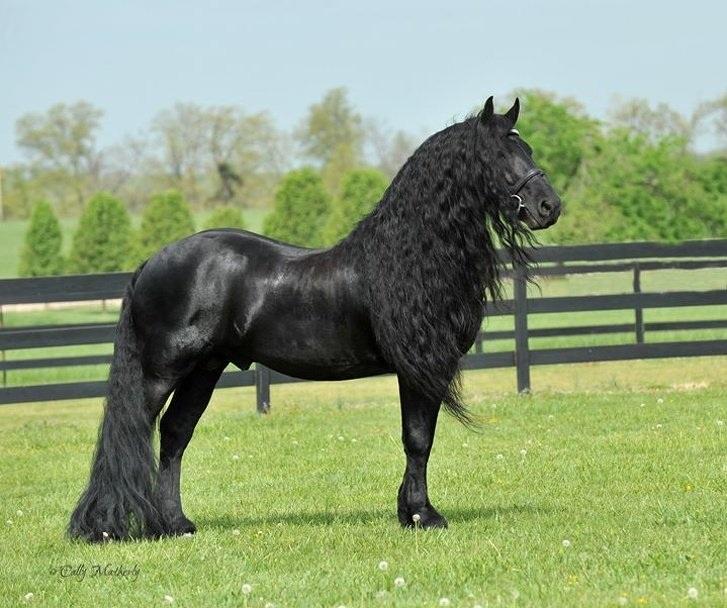
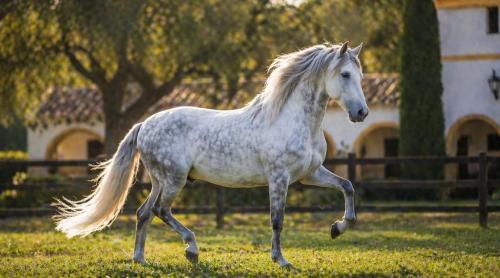
It is a medium-sized, well-proportioned horse, standing 1.52 to 1.62 meters at the withers. It features a short coat and a long mane that stands out against its body; its weight ranges from 400 to 650 kg. Exhibiting marked sexual dimorphism, it is a hardy animal capable of withstanding specific temperature ranges with significant resilience. The head is medium-sized with a sub-convex profile, featuring medium-sized parallel ears, large and expressive eyes, and slanted nostrils. Its neck is muscular, strong, and robust, highlighting its elegance, while the chest is broad and well-muscled. The torso is proportional to the body, featuring a rounded, medium-sized, and sloping croup. The Andalusian horse comes in various colors such as black, bay, palomino, gray, chestnut, and white?though the most common is dapple-gray; it does not exhibit spotted coat patterns.
The breed is highly prized for its beauty, speed, and elegance. It is widely used in classical dressage and other equestrian sports, such as bullfighting activities that demand high energy, great aptitude, and specific physical traits. Historically known as a "war machine, it was used in major battles. The Andalusian is extremely intelligent and responsive to specific commands, making it highly valued for field activities like cattle herding. Easy to train and primarily suited for riding, it possesses a balanced and harmonious temperament, characterized as both submissive and courageous.
Regarding stallions, it is important to note that the average age at the birth of their first offspring is between four and five years; thus, most of these horses sire their first foal before the age of six. The age at which a stallion produces his last offspring falls between 11 and 12 years, marking the end of his reproductive lifespan. Their average reproductive lifespan is 4.4 years. There has been a marked turnover in the breeding stock, a trend indirectly linked to the decline in productive lifespan observed in recent years.
As for mares, their first foaling occurs at around five and a half years of age, making them earlier to start breeding than stallions. The interval between foalings can vary but averages close to 20 months; the final foaling occurs when the mare is between 11 and 12 years old, resulting in a reproductive lifespan of approximately seven years longer than that of stallions.
The Andalusian horse breed stands out for its popularity and preference in specific competitive activities and daily field work. It is evident that the horse possesses the agility and conformation suited for sports and labor, thanks to its hardiness demonstrated by its resilience to various weather conditions and its ease of adapting to commands. The breed's genetic significance is also noteworthy; the Andalusian gave rise to several other breeds now found worldwide and utilized for the same purposes as the Pure Spanish Horse. Ultimately, the breed is distinguished by its elegant, docile, agile, and strong nature, making it an excellent choice for riding.
Fonte: Contemporary Journal
