


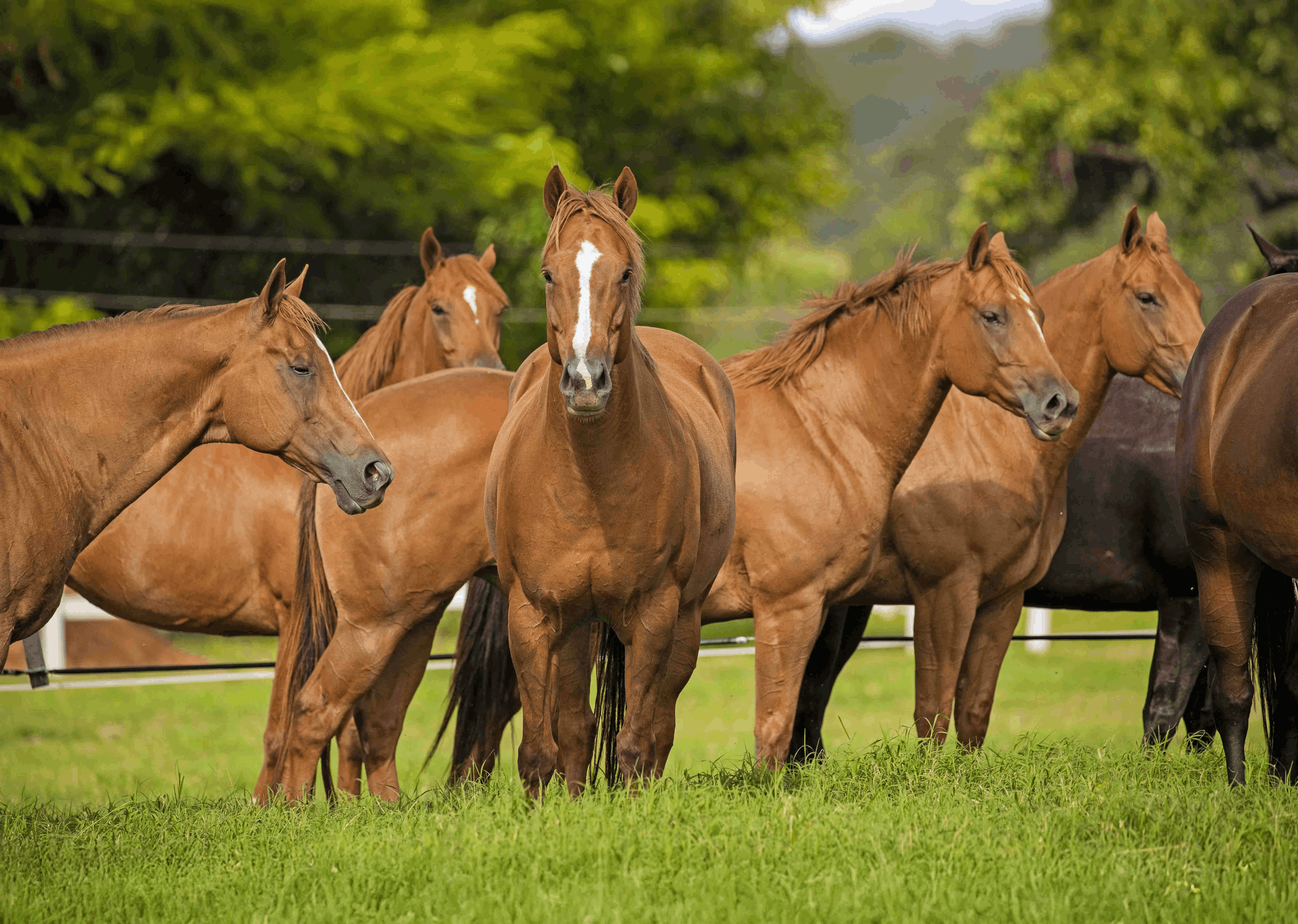
The Quarter Horse was the first breed developed in the Americas. It originated in the United States around the year 1600. The initial stock was brought to North America from Arabia and Turkey by Spanish explorers and traders. Selected stallions were bred with mares imported from England. This crossbreeding produced compact, heavily muscled horses capable of running short distances faster than any other breed. The horse became specialized for working with cattle. On weekends, colonists amused themselves by holding races?covering a distance of a quarter-mile (402 meters)?along village streets and country roads near the plantations, giving rise to the breed's name.
Check out the details of the Quarter Horse breed standard and learn more about the breed:
APPEARANCE - Conveys strength and tranquility. When not working, the horse remains calm, keeping its strength under control. When standing still, it remains collected, with the hindquarters positioned under the body and weight distributed across all four feet, ready to move quickly in any direction.
COAT - Accepted Quarter Horse coat colors include sorrel, liver chestnut, bay, buckskin, palomino, brown, roan, gray, dun, black, and seal brown. Animals with pinto, paint, or white coat patterns (in any of their varieties) are not accepted for registration.
GAIT - Harmonious, straight, natural, and low-moving. The foot is lifted freely and placed back on the ground in a single motion, characteristic of the working trot.
HEIGHT - Average height is 1.50 meters. They are robust and heavily muscled.
WEIGHT - Average of 500 kilograms.
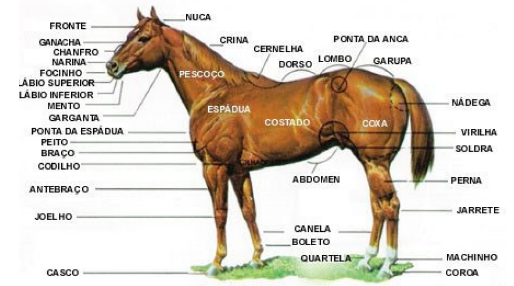
HEAD - Small and light. In a natural position, it joins the neck at a 45-degree angle. Straight facial profile.
CHEEKS - Full, large, and very muscular; round and flat when viewed from the side; slightly convex and flaring outward when viewed from the front, resulting in a jaw width that is significantly greater than the throat width. This structure allows for pronounced head flexion, resulting in great responsiveness to the reins.
FOREHEAD - Broad.
EARS - Small, alert, and set well apart.
EYES - large and, due to the broad forehead, set wide apart, allowing for a wide field of vision?both forward and backward simultaneously with the same eye.
NOSTRILS - large.
MOUTH - shallow, allowing for great sensitivity to the bit.
MUZZLE - small.
NECK - medium length. It should join the body at a 45-degree angle yet remain clearly distinct from it. Only the transition between the neck and the withers should be gradual.
UNDERLINE - of the neck is comparatively straight and must be clearly defined from the body, ensuring flexibility.
TOPLINE - straight when the horse's head is in the normal position.
THROAT - narrow, allowing for great responsiveness to the reins.
MUSCULATURE - well-defined, whether viewed from the side or from above. Mares have a proportionally longer neck, a narrower throat, and less muscle development. When working, the Quarter Horse keeps its head low, allowing for better use of the head and giving the rider a clear view over it.
BODY - from withers to loin, it must be short and well-muscled; not "swaybacked," especially in working horses. This allows for rapid changes of direction and great resilience against the weight of the rider and tack. In profile, a gradual slope of 5 to 8 degrees from the croup to the base of the withers is acceptable. The peak of the withers and the junction of the loin and croup should be at approximately the same level.
WITHERS - well-defined, of medium height and thickness.
BACK - well-muscled alongside the vertebrae and, viewed in profile, showing a very slight slope from rear to front. It has a somewhat flat appearance, and standard tack should cover this entire area.
LOIN - short, with exceptionally strong musculature. CROUP ? long and gently sloping, allowing the animal to keep its hindquarters naturally well-positioned beneath its body mass (natural engagement).
CHEST - deep and broad. Viewed in profile, the chest must clearly extend beyond the line of the forearms, yet taper at the upper curve to clearly distinguish it from the neck. Viewed from the front, the area between the forelegs forms an inverted "V" shape, due to the well-developed musculature of the arms and forearms.
SHOULDER - should have an angle of approximately 45º, be well-defined and balanced, allowing for the absorption of shock transmitted through the limbs.
ARMS - muscular, both on the inner and outer sides.
FOREARMS - the extension of the inner arm musculature gives the lower chest?when viewed from the front?an inverted "V" shape, lending the horse an athletic and healthy appearance. The outer forearm musculature is also pronounced. The length of the forearm is one-third to one-quarter greater than that of the cannon bone.
KNEES - viewed from the front, they are full, large, and round; viewed in profile, they are straight and free of deviations.
CANNON BONES - not overly short. Viewed from the side, they are flat, following a straight line from the knee to the fetlock; viewed from the front, they are likewise free of deviations.
PASTERNS - medium length, clean, set at a 45º angle (identical to the shoulder), and continuing into the hooves at the same slope.
HOOVES - medium size, approximately semicircular in shape, with widely spaced heels and no deviations.
THIGHS - long, broad, flat, powerful, well-conformed, and strongly muscled; wider than the croup.
STIFLE - covered by well-defined, powerful musculature.
GASKINS (LOWER THIGHS) - very muscular. Uniform muscle development?both internally and externally?is essential.
HOCKS - low-set. Viewed from behind, they are broad, clean, and correctly aligned; in profile, they are broad and powerful, extending in a straight line down to the fetlocks.
CANNON BONES - broader, slightly longer, and thicker than those of the forelimbs. Viewed from the side, they are flat. Shorter cannon bones are desirable, as they bring the hock closer to the ground, facilitating quick turns and sudden stops.
Sorrel - Liver Chestnut - Buckskin - Palomino - Bay - Cremello - Grullo - Perlino - Black - Red Roan - Gray - Dark Bay.
It all began in February 1954 at Fazenda Bartira, when Swift King Ranch (SKR) imported the stallion Saltillo Jr. and six mares from the United States specifically from its North American parent company, the famous King Ranch in Texas, which was the largest ranch at the time. As various ranchers, bankers, and businesspeople were introduced to Quarter Horses, they began pressuring SKR to sell them some of the animals. The company accommodated only a few breeders, selling a limited number of foals. On August 15, 1969, the Brazilian Quarter Horse Breeders Association (ABQM) was founded at Parque da Água Branca in São Paulo.
According to data provided by the ABQM Stud Book as of September 30, 2024, the Quarter Horse population in Brazil consists of 704,796 registered animals (564,862 living and 139,934 deceased), owned by 154,454 individuals. Of this total, 73,365 are breeders and 53,001 are registered members, distributed across every Brazilian state.
These herds consume approximately 1.2 million tons of feed annually, representing an expenditure of around R$ 950 million. The directly employed workforce is also substantial, accounting for over 463,000 direct jobs (an average of three employees per property). This figure excludes veterinarians, agronomists, animal scientists, farriers, staff at training and breeding centers, auctioneers, carpenters, masons, electricians, woodworkers, horse transporters, equipment manufacturers, and the feed and veterinary product industries, among others.
In 2024, through the end of October, the ABQM Stud Book registered more than 22,100 foals. During the current season, the Association also awarded thousands of belt buckles to champions and trophies to the top three finishers, in addition to providing over R$ 16 million in prize money across its official events. These include the Brazilian Congress, National Championship, and *Potro do Futuro* / Champions Cup / Brazilian Conformation and Working Derby; *Potro do Futuro* / National Championship and Brazilian Congress / Champions Cup / Brazilian *Vaquejada* Derby; *Potro do Futuro* / National Championship / Brazilian Derby, Brazilian Congress, and Champions Cup for *Laço Comprido* (Long-Rope Roping); and the *Potro do Futuro* / King and Queen of Speed (Racing).
It adapts to any situation, serving as a source of power and a means of transport, proving hard to beat in equestrian competitions, and acting as an improver of breeding stock. Considered the most versatile horse in the world, it is used in Halter, Working, and Racing disciplines.
